
From a domain name to something useful
CookMySite started with little more than a domain name. I registered cookmysite.co.uk because I really liked the sound of it, but at the time I had no clear idea what I wanted to build there.
Rather than turning it into another brochure website that simply existed and hoped to generate clicks, I wanted to make something useful. The idea became a lightweight website health checker that could give people something back straight away, while also giving me a personal project where I could build more experience with Node.js and application development.
Building a live website checker
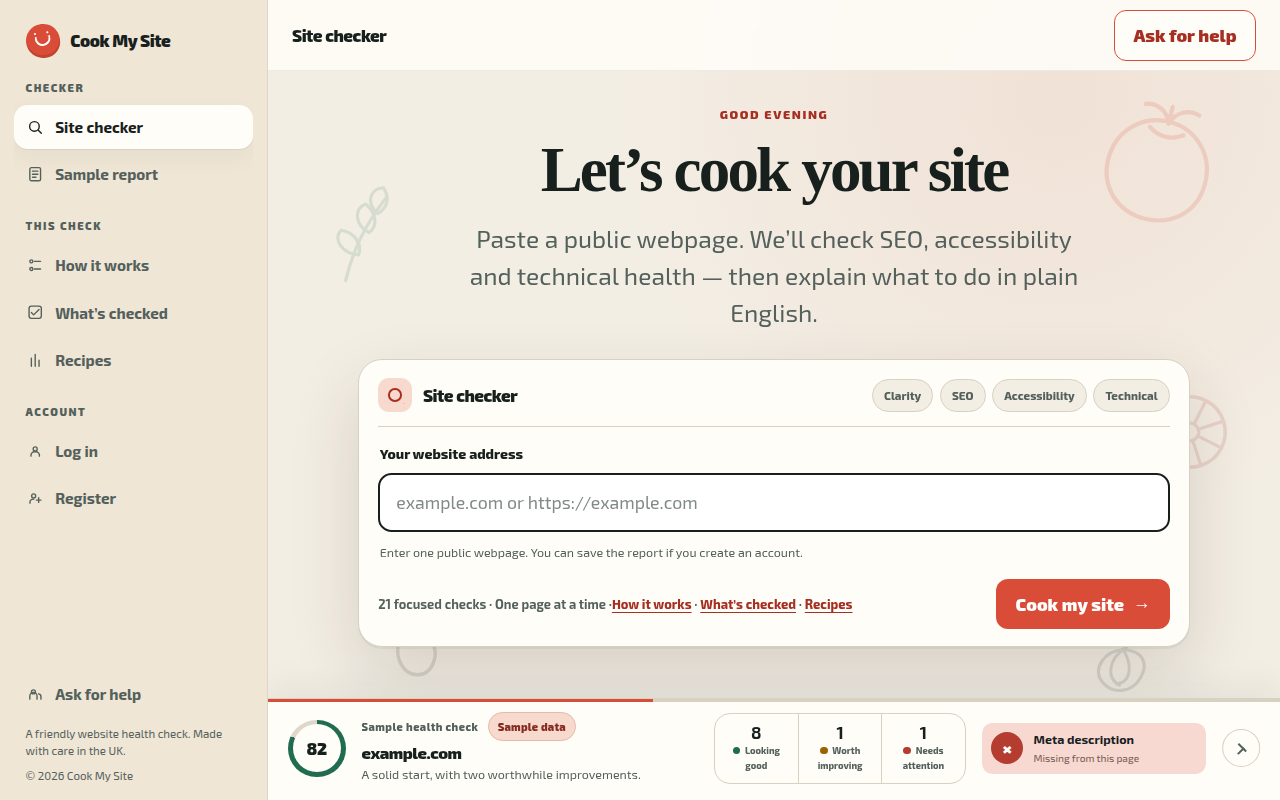
The app lets someone enter a public webpage and runs a focused set of checks across clarity, SEO, accessibility and technical health. The current version includes 21 checks, a dedicated report experience, plain-English explanations and practical recipes for common fixes. Optional accounts can also save reports to a private history after email confirmation.
The aim was to avoid producing a wall of technical warnings. I wanted the experience to feel approachable and useful to people who might not spend their day thinking about metadata, heading structure or accessibility. That thinking also shaped the visual direction. CookMySite has a warmer, cosier interface than a typical audit tool, which felt much more appropriate for the name and helped give the project its own personality.
Why Astro?
I chose Astro because it suited the balance CookMySite needed between a lightweight interface and server-side application functionality. Much of the experience can be rendered without shipping a large JavaScript bundle to the browser, while Astro’s Node adapter still allows the application to run as a standalone Node.js server when live functionality is needed.
That makes it a good fit for a tool where performance is part of the product itself. The interface stays relatively lean, while the server can handle tasks such as fetching and analysing public pages, generating reports and supporting account functionality. TypeScript adds another useful layer as the number of checks and application features grows, making the codebase easier to reason about and maintain.
For the auditing itself, the app uses server-side Node.js code and Cheerio to inspect returned HTML. Astro then provides the surrounding application structure and rendered interface, rather than forcing the entire experience into a client-heavy single-page application.
AI as a pair-programming tool
CookMySite has also been a useful way to explore AI-assisted development as part of the learning process. I have used AI as a pair-programming partner while working through architecture, unfamiliar Node.js patterns, auditing logic, testing and interface ideas.
The value for me has been in using it to explore approaches, question decisions and iterate faster while still understanding and refining the code being produced. That makes the project as much a learning exercise as it is a finished piece of work.
Where it is now
CookMySite is currently at the point where I am testing the waters. It is live and functional, but I am treating the current version primarily as a demonstration of web-app development rather than pretending it is already a finished commercial product.
If people genuinely find it useful and start using it, the next step would be to invest more time into turning it into a higher-quality tool with deeper checks and a more complete product experience. For now, it has already achieved the original goal: taking a domain I liked but had no plan for and turning it into something useful, technically interesting and capable of growing into more.