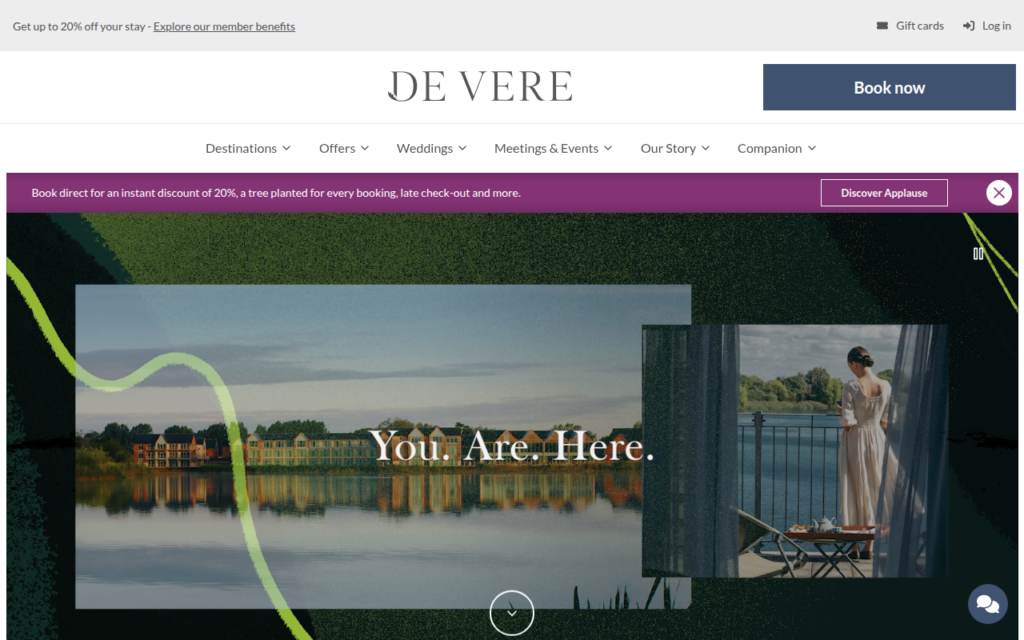

De Vere operates a large hospitality website spanning hotels, weddings, meetings and events across its UK estate. I work alongside the wider CRO team on an ongoing experimentation programme, taking ideas from technical feasibility through development, QA and launch.
The work covers everything from small messaging and CTA experiments to new booking interactions, navigation improvements and more complex front-end experiences. Rather than committing immediately to permanent changes, experimentation allows the team to validate ideas with real users and build evidence around what improves the customer journey.
My role
CRO development. Building experiments ranging from small UI changes to substantial new interactions.
Technical feasibility. Investigating existing behaviour and determining how ideas can be implemented reliably.
SiteSpect. Developing experiments within De Vere’s experimentation environment and choosing approaches that suit both the platform and existing website.
QA. Cross-browser, responsive and journey-based testing before experiments launch.
Improving the booking journey
A large proportion of the experimentation I work on sits within the hotel booking process.
Not every experiment needs to completely change the experience. Some of the most useful tests can be relatively small, such as adjusting messaging, changing the prominence of calls to action or reconsidering what information is shown while someone is choosing and booking their stay.
The important part is understanding what is most useful to the customer at that particular point in the journey.
Other experiments can involve more substantial changes to the interface or booking experience. My role is to understand the intention behind each idea and find a reliable way of implementing it within the existing website while keeping the experience consistent across devices.
Testing what De Vere should showcase
Experimentation also extends beyond the booking journey.
We’ve worked on the homepage to explore how De Vere’s wider services and offering can be communicated more effectively. This can involve creating and testing new messaging ourselves or working with the De Vere team to understand which parts of the business they would most like to showcase.
From there, we can turn those ideas into experiments and understand how changes to content, hierarchy and presentation affect the way visitors engage with the website.
It gives De Vere the opportunity to test how they communicate their offering rather than relying purely on assumptions about what customers want to see.
Solving real usability problems
Some experiments are driven by usability issues we’ve identified within the existing website.
One example has been De Vere’s main navigation. On smaller devices, the expanded navigation could become difficult to use, making it harder for visitors to move through the available menu options.
We explored ways of improving that interaction and created an alternative navigation experience that made those expanded menus easier to use on smaller screens.
This is the type of CRO work I enjoy most because the development is not simply about producing a new design. It involves understanding an existing interaction, identifying where the friction comes from and finding a solution that can be tested without disrupting the rest of the website.
Technical feasibility
A large part of my role happens before an experiment is ever built.
Ideas need to work within an existing website, and that often means investigating how pages are structured, how content is rendered and how existing components behave before deciding on the best implementation.
Some concepts are straightforward, while others require us to rethink the original approach or find another way of achieving the same goal.
Being involved at this stage means I can help the CRO team understand what is technically possible, flag potential problems early and suggest alternatives where an idea may be difficult or unreliable to implement as originally proposed.
Developing with SiteSpect
De Vere uses SiteSpect as its primary experimentation platform.
Working extensively with the platform has been a useful part of the project because its approach differs from the more traditional client-side experimentation tools where changes are commonly injected into the page through a JavaScript tag.
SiteSpect’s delivery model has meant developing a different understanding of how experiments should be structured and implemented.
Over time, working with the platform has allowed us to become much more confident in what can be achieved with it, how to approach more complex experiments and how to build changes that work reliably within De Vere’s existing website.
That knowledge also feeds directly into feasibility. Rather than simply asking whether something can be built with JavaScript, I can consider how the experiment will actually be delivered through SiteSpect and choose an approach that suits both the platform and the website.
Building more complex experiments
While some tests might only involve copy or visual changes, others behave much more like traditional front-end development.
These experiments can involve creating new components, handling user interaction, maintaining state, responding to existing website behaviour and ensuring everything continues to work responsively across different devices.
The challenge is often introducing something significantly different without having direct control over the underlying website.
That makes understanding the existing implementation just as important as writing the experiment itself.
QA and confidence before launch
Experiment development does not stop once something looks correct on my own screen.
I also spend a significant amount of time testing experiments across different devices, browsers, screen sizes and user journeys to make sure they behave consistently and do not interfere with existing functionality.
This becomes particularly important within areas such as the booking journey, where even a small technical issue could introduce friction at one of the most important points of the customer experience.
For more complex work, automated testing can also help us validate important interactions and give the team additional confidence before an experiment is exposed to users.
The outcome
Rather than relying on assumptions or committing immediately to permanent changes, De Vere can use experimentation to understand how real customers respond to changes across the booking journey and wider website.
My role helps make that possible from a technical perspective, combining feasibility, development and QA so ideas can be tested reliably within the existing platform. Over time, those experiments build a clearer picture of what improves usability, engagement and ultimately the commercial performance of the website.